
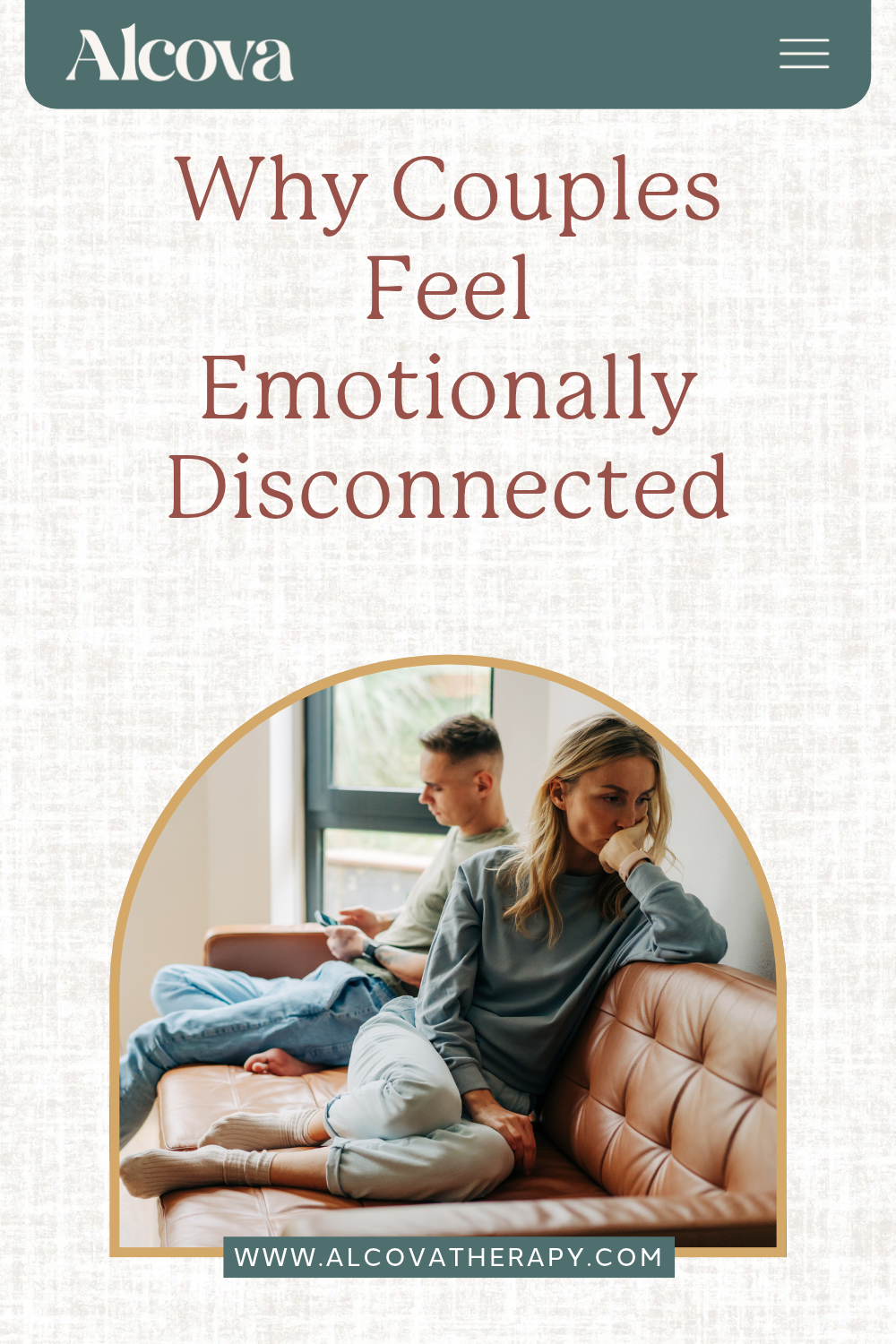
A couple can share a home, a calendar, parenting duties, and even a bed while feeling profoundly alone with each other. When people ask why couples feel emotionally disconnected, they are often not describing a lack of love. They are describing the painful sense that their partner no longer feels reachable - or that reaching for them has begun to feel risky.
Emotional disconnection rarely appears all at once. More often, it grows quietly through small missed moments: a concern brushed aside after a long day, a difficult conversation postponed, a bid for affection met with distraction, or an argument that ends without either person feeling understood. Over time, partners may stop bringing their inner world to one another. They become efficient roommates, capable co-parents, or polite companions, while the relationship feels less like a place of comfort and more like another source of strain.
The good news is that disconnection is not usually a final verdict on a relationship. It is often a pattern that can be understood, softened, and changed with supportive and intentional care.
Why Couples Feel Emotionally Disconnected Over Time
Emotional closeness depends on a felt sense of safety: the belief that you can turn toward your partner when you are hurting, uncertain, ashamed, or overwhelmed and find some measure of care. When that safety is weakened, people tend to protect themselves. One partner may criticize, press for answers, or become increasingly upset. The other may withdraw, shut down, become defensive, or focus on practical tasks instead of feelings.
Neither response necessarily means someone does not care. In fact, both can come from a deep desire for connection. The partner who pursues may be saying, beneath the frustration, “I need to know that I matter to you.” The partner who pulls away may be saying, “I am afraid I will fail you, disappoint you, or make this worse.” Unfortunately, these protective moves can create a cycle where each person’s response confirms the other’s fear.
This cycle is often more damaging than the issue that started it. Couples may believe they are fighting about money, household labor, sex, parenting, or time together. Those concerns matter, but the deeper injury is frequently relational: “When this happens, I feel alone,” “I do not feel like you are on my side,” or “I do not know how to reach you anymore.”
The Everyday Pressures That Create Distance
Life can place enormous pressure on even a strong relationship. A demanding career, financial uncertainty, caregiving, infertility, pregnancy, raising young children, chronic illness, grief, or a move can leave little room for unhurried connection. Many couples respond by focusing on what must get done. They divide tasks, manage schedules, and keep moving.
That practicality can be necessary for a season. But when logistics become the primary language of the relationship, emotional needs may go unspoken. A conversation about who is picking up dinner can replace a conversation about exhaustion, loneliness, or the fear of not being enough. Partners may not realize how far apart they have grown until a minor disagreement carries a surprising amount of intensity.
Technology can add another layer. Phones and streaming are not inherently harmful, and quiet time together can be restorative. The concern is not screen time by itself, but what it replaces. If every quiet moment is filled with work messages, scrolling, or separate entertainment, there may be fewer openings to notice one another and reconnect.
Unresolved Hurt Changes How Partners Reach for Each Other
A relationship can also become emotionally distant after hurts that were never fully repaired. This may include a breach of trust, a period of depression, an unequal division of responsibilities, harsh words during conflict, sexual rejection, or feeling unsupported during a major life event. Some injuries are obvious. Others are made up of many small moments when one person felt dismissed, criticized, or left alone.
When hurt is not named and processed, it does not simply disappear. It can show up as irritability, numbness, avoidance, resentment, or a reluctance to be vulnerable. A partner may say, “I am fine,” while carrying a growing belief that sharing honestly will not help.
Repair does not require couples to agree on every detail of the past. It does require enough openness to recognize impact. A meaningful repair sounds less like proving who was right and more like, “I can see why that felt painful. I want to understand what you needed from me then, and what would help now.” For many couples, this kind of conversation is difficult to have without structure, especially when old conflicts quickly take over.
Different Coping Styles Can Look Like a Lack of Care
People learn different ways of handling stress and emotion long before they enter adult relationships. One person may seek closeness when distressed and want to talk right away. Another may need time alone to settle their thoughts before they can engage. One may express love through practical help, while the other feels most cared for through affection, reassurance, or focused attention.
These differences are not automatically a problem. They become painful when partners interpret them personally. The person needing space may be seen as cold or uncaring. The person seeking conversation may be seen as demanding or impossible to satisfy. Both partners can end up feeling misunderstood.
The goal is not for either person to abandon their natural style. It is to build a bridge between them. That can mean saying, “I need 30 minutes to calm down, and I will come back to this,” rather than leaving the room without reassurance. It can also mean saying, “I am not asking you to fix this immediately. I need you to stay with me while I talk about it.” Small changes in clarity can reduce the fear that drives disconnection.
Emotional Disconnection Is Not Always About Communication Skills
Communication tools can be helpful, but they are not always enough. A couple may know how to use “I” statements and still feel distant because the emotional meaning beneath the conversation remains untouched. If one partner says, “You never ask about my day,” the deeper message may be, “I miss feeling important to you.” If the other responds only to the literal complaint, both people may leave the conversation feeling unseen.
This is one reason Emotionally Focused Therapy, or EFT, can be so meaningful for couples. EFT helps partners recognize the negative cycle they get caught in, access the more vulnerable emotions beneath their protective reactions, and practice reaching toward one another in new ways. Rather than treating one partner as the problem, the work focuses on the pattern that has taken hold between them.
It is also worth making space for individual factors. Anxiety, depression, trauma, burnout, substance use, chronic pain, and major hormonal or medical changes can all affect emotional availability. A partner who seems withdrawn may be overwhelmed internally. That does not erase the impact on the relationship, but it can create a more compassionate starting point for understanding what is happening.
How to Begin Rebuilding Emotional Connection
Reconnection is rarely created by one grand gesture. It is built through repeated experiences of turning toward each other with greater honesty and care. Start with a conversation outside of conflict, when neither of you is rushed or already activated. Rather than leading with what your partner is doing wrong, try naming what you miss and what you hope for.
For example: “I have been feeling distant from you lately, and I do not want us to keep drifting. I miss feeling like we are a team. Could we talk about what has been hard for each of us?” This approach does not guarantee an easy response, but it is more likely to invite connection than blame.
Make the ask specific and realistic. A weekly check-in, a phone-free walk, ten minutes of conversation after the children are asleep, or a clearer plan for returning to a difficult discussion can matter more than vague promises to “communicate better.” Consistency is more healing than intensity.
During hard conversations, pay attention to the cycle rather than only the content. When one person gets louder, does the other become quiet? When one person becomes quiet, does the other pursue harder? Naming the pattern together can create a little distance from it: “We are doing that thing again where I push because I feel scared, and you pull away because you feel overwhelmed.” That language makes room for compassion without excusing harmful behavior.
When Couples Counseling Can Help
Some couples can shift these patterns on their own, particularly when the distance is recent and both partners feel willing to engage. Others benefit from a skilled therapist who can slow conversations down, help each person feel heard, and guide the relationship toward new emotional experiences.
Couples counseling can be especially helpful when conflict repeats without resolution, resentment is growing, trust has been damaged, intimacy has changed, or one or both partners feel lonely in the relationship. It is not reserved for couples at the edge of separation. Seeking support earlier can make repair feel more possible and less urgent.
At Alcova Therapy, couples work is grounded in evidence-based approaches and a belief that meaningful change requires both science and humanity. Therapy offers a structured space to understand what is happening beneath the arguments, practice new ways of responding, and rebuild a relationship where both partners can feel safer being known.
Feeling disconnected can be frightening, particularly when you remember how easy closeness once felt. But distance is often a signal that something tender needs attention, not proof that your relationship is beyond repair. With patience, honest conversations, and the right support when needed, partners can begin creating the small, steady moments that make connection feel possible again.
